|
There are many
varieties of instruments known as bagpipes
throughout Europe and in parts of Asia, but in the
Celtic world of the British Isles, there are two
main types, The Irish (Uillean or Elbow) and the
Scottish (Great Highland or Small Border). How do
we distinguish between them?
The Great
Highland (Bagpipe) is probably the most prolific
bagpipe worldwide today, due in no small part to
the vast extent of the British Empire in the 19th
century. The English military appropriated the
ancient Scots use of the bagpipe as a tool of
intimidation and inspiration in war, and developed
military marching bands which accompanied their
troops throughout 'the colonies'. Hence, the
playing of the Highland Pipes is very widespread
today from New Zealand and Australia, India and
Pakistan, through to Canada and the United
States.
The bag is blown
full from the player's mouth through a blow-pipe
and the pressure from the left arm on the bag sends
and controls the flow of air to the melody chanter
and three drones. The range of tones which can be
produced from the eight small holes in the chanter
is limited to only nine, spanning an octave and a
tone or second. The sound is produced when the air
is forced through a small double-sided reed made
traditionally from cane and more recently from
plastic. Because the pipe is mouth-blown, the air
is laden with moisture and operates in a damp
state. The tonic notes are pitched about B flat and
the scale includes a flat 7th. The limited scale
and melodic possibilities, as well as the
ever-present drones, give the music both haunting
and mesmerizing characteristics.
Historically the
instrument was played outdoors for community dance
music, in a solo or 'sean nos' style, leaving much
room for individual interpretation. For the
advanced player, the ancient repertoire of
'pibroch' remains the ultimate challenge for the
solo piper, a canon of slow and mournful set
pieces, demanding advanced technique and thoughtful
expression. The military band appropriation
necessitated a high degree of conformity of melody
and gracings, providing solid training for the
aspiring piper, but inevitably causing frustration
of individual expression.The Highland piper usually
stands while playing and often will walk slowly in
a small circle, measuring his steps with the beat
of the music.The Small Lowland or Parlour pipes are
a scaled-down, indoor version of the Highland pipes
and are blown from a bellows strapped to the right
arm. They produce a much quieter and more refined
sound, and have become popular in recent years with
folk and traditional groups. These pipes are
pitched in the more 'sociable' keys of A and D,
making them ideal for ensemble playing.
|
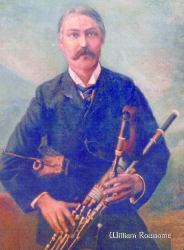
The
Uillean (elbow) pipes of the Irish
tradition are quite a different matter. As
the name suggests, they are blown from a
bellows located on the right arm, and
again, the air is collected and controlled
from the bag under the left arm. Pressure
on the bag feeds the air to the reeds of
the melody chanter, as many as three
drones, and three regulator stocks, each
fitted with keys which can provide
occasional or constant chordal
accompaniment. These regulator keys are
played with the inner wrist of the right
hand, while fingering the chanter, thus
necessitating masterful co-ordination. The
player sits forward on a chair, the open
end of the melody chanter placed on the
right thigh and it remains there,
effectively closing the chanter when all
eight holes are covered. The notes are
produced by lifting one or more fingers
off the chanter to open one or more holes,
or, in the case of the lowest tonic note,
lifting the end of the chanter off the leg
while covering all the fingered
holes.
|
|
Thus we
observe a major difference between the
Scottish and Irish pipes.The Highland
chanter is always open at the end and thus
the melody is continuous. The Irish
chanter operates principally in a closed
fashion, making it possible to stop the
sound, often imperceptibly. This allows
for a vastly different fingering technique
which can produce a wide variety of
melodic and ornamental effects.
The
range of the Irish chanter is two full
octaves, and with the addition of several
keys, can be played chromatically; that is
sounding all the black and white notes of
the keyboard. The pipes can be pitched in
a variety of keys, based on the tonic
'concert' D, or the 'flat sets' in C#, C,
B or B flat.The lower the pitch of the
pipes becomes, the quieter and sweeter is
the tone that results.
Concert
'D' pipes are popular in modern times
because they can be played readily with
most other instruments and they have a
bright and present sound.The flat sets
were more popular in times past, but are
currently enjoying a revival, as players
search for more tonal colours for their
palette.
The full
set of Uillean pipes were designed as a
mini-orchestra, complete with melody,
chordal accompaniment and drones. A lever
allows the drones to be switched on or off
as desired, and the regulator work is an
individual style-choice, ranging from
rhythmic hits to full chords. Because the
fingering proceeds from a closed system, a
wide variety of style and ornamentation is
possible, giving the player much
discretion in how he/she interprets the
music. Laments and slow airs are
especially effective and demonstrate the
mature player's mastery of technique. A
multitude of fingering options coupled
with effects produced by lifting the
chanter 'off the knee' allow a broad range
of personal expression, a quality which is
expected of the advanced
player.
The
chanter reed is also double-sided, made
from cane, though longer and much more
delicate then the Highland chanter reed.
The Highland reeds are often bought by the
dozen from suppliers and thus are quite
disposable and somewhat interchangeable
between sets. The Irish reeds, on the
other hand, are very sensitive to humidity
and temperature, and are almost always
uniquely fitted to each chanter, often by
the pipemaker himself. A good one, well
cared-for, can last for many years.Irish
pipers often must master the art of reed
making, as well as reed adjustment and
maintenance. Trust me, this is no simple
task.
In
conclusion, each of the traditions of
bagpiping is replete with a body of
repetoire, technique and playing
opportunities. Of late, there have been
more and more interchanges between the
two, as it is quite possible to set Irish
melodies on the Scottish chanter, and
visa-versa. Bagpipers occupy a somewhat
rarified world, inhabited by devotees and
connoisseurs, as well as practitioners.
Perhaps not surprisingly, the passion for
bagpiping shows no sign of waning and is
probably more widespread in today's world
than at any time previous. Like fine
whiskey, with one small taste, you may be
hooked for life.
David
Papazian is a musician and luthier.
He plays violin, concertina and Irish
Pipes.
www.cranfordpub.com/papazian
David
Papazian
papazianviolins @ yahoo.ca
|
Recordings
of Irish Pipes
Recordings of
Scottish Pipes:
Books
of Highland Pipe Tunes
|

