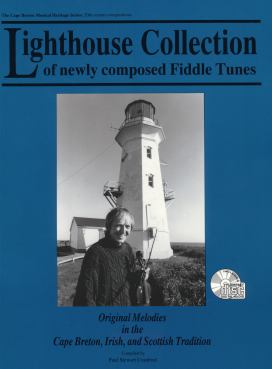
|
The Lighthouse
Collection of newly composed Fiddle Tunes, Original
Melodies in the Cape Breton, Irish, and Scottish Tradition,
Compiled by Paul Stewart Cranford
Now that's a long title
and this is a very good book. For nearly twenty years now,
Paul Cranford has been publishing both high quality reprints
of classic 19th century Scots fiddle tune books and
well-designed new collections of newly composed tunes by
late 20th century Cape Bretoners. The focus of this new book
is the compositions of the publisher himself augmented by
selected works of a dozen of his friends and prime
influences.
The collection includes
most of the usual Celtic tune types as well as a sprightly
"slip
reel." The reels
are particularly well crafted and appear to be mostly
inspired by the Irish/Scottish confluence (with a
subterranean French influence) that is found in the music of
some of Cranford's mentors and exemplars such as Johnny
Wilmot, Joe Confiant and others. Some of the tunes are
serious, others just plain fun, and a few, like the single
jig "Siobhan,"
are flat-out gorgeous.
There
are special touches here. Through blurbs at the start of
tune sections and frequent footnotes, Cranford's musical
biography is woven into the fabric of the book. And a 68
minute CD containing performances of many of the tunes is
nestled in a plastic sleeve affixed to the inside back
cover. There is also one
perplexing feature:
staff notation of melodic form has been confused with a map
of finger placement. Thirteen tunes are written for raised
bass tuning with the notes put as if the fiddle were tuned
standard, which effectively protects them from ever being
played by any instrument but a cross-tuned
fiddle.
by
Jody Stecher, California, Winter 1997
another
review
...from Canadian Folk Bulletin
Plus Paul's
CDs
The
Lighthouse:
Cape Breton Fiddle Music by Lighthousekeeper Paul
Cranford and Friends (recording only - CD or
cassette)
More
Tunes from the
Lighthouse
(2010)- 2CD set - 113 tunes from the Lighthouse
Collection performed by Paul Cranford and Mario
Colosimo.
Photographs
from
The Lighthouse Collection
(all photographs by Wayne Barrett)
Machias
Seal Island
| Cranford
the Birdwatcher
| Cranford
Biography
|