|
|
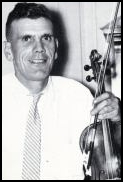
JOHNNY WILMOT
died in April of this year (1993). During our long
friendship he introduced me to dozens of musical
people around the Cape Breton countryside. I will
never forget his generosity and inspiration. They
say his fiddling used to drive the dancers crazy.
He certainly turned my life around. I remember the
first night I met him and his uncle Joe Confiant,
at Teddy Snow's place. When I returned home around
midnight, I was so wound up that I stayed up
learning tunes till dawn.
A native Cape
Bretoner, Johnny was born in 1916. His father was
from Mabou and Johnny spent the first three years
of his life there. Afterwards he was brought up
with his mother's people, his grandparents, the
family of his uncle Joe Confiant, in Centerville,
between North Sydney and Sydney Mines.
|
Both Johnny and Joe
learned some of their music by listening to their uncle,
Henry Fortune. The Fortunes were from Bras d'Or, Cape Breton
County. They were accomplished Irish fiddlers who in
Johnny's words played with "long-slurred-bowing" complete
with lots of fingered embellishments. Differing from the
Fortunes, Joe added a variety of new types of embellishments
to his music, some of which he likely gleaned from the Cape
Breton Scottish traditions and others from the recordings of
Sligo fiddlers. His bowing included effortless bowed cuts
(trebles) regardless of direction, momentum or positioning.
His music was lively and yet the tempo wasn't fast. His
timing was rock solid for dancers even when improvising.
Although Johnny played Cape Breton Scottish style tunes with
the best of them, most remember him for his Irish music.
During the fifties, Johnny Wilmot and his Irish Serenaders
played a regular live radio broadcast from CJCB Sydney
… Irish music with a Cape Breton swing. His 78 records,
made in the same studio, with Tommy Basker and Margaret
MacPhee, all featured Irish tunes, played with his
characteristic drive and intensity. During this period he
made three trips to Boston where he played with, and for,
some of the legendary figures of Irish music, including
Paddy Cronin and Joe Derrane. Paddy was heard to say that
Johnny was the liveliest Irish jig player he had ever
encountered.
Musically, Johnny was
fluently bilingual. He was one of the few musicians I ever
met who had thoroughly digested both Cape Breton Irish and
Cape Breton Scottish styles. While his own compositions
often straddled this Irish-Scottish fence, his settings of
traditional tunes kept the two separate, always displaying
personal style without sacrificing the beauty and integrity
of the 'original' melodies.
Johnny was exposed to live
Irish and Scottish styles of music from the time he was an
infant. Starting in the late 'twenties he began listening to
the Irish 78s of Coleman, Morrison etc. and and later to the
Cape Breton 78s of the Inverness Serenaders. He played most
of the 'mainstream repertoire' including the majority of
tunes recorded and played by other Cape Breton fiddlers
between 1930-65. Many of these tunes were found in easily
available books such as Cole's One Thousand Fiddle Tunes, J.
Scott Skinner's, The Scottish Violinist, The Scotch Guard
and The Skye, O'Neill's and Kerr's Collections.
Many of the 'traditional'
tunes in his repertoire were Scottish, Irish and Cape Breton
composed, some were 'Northside Irish' tunes from his uncles
Joe Confiant and Henry Fortune, and some were Inverness
County tunes. He also played a variety of other tune types
&emdash; French and 'Oldtime' American tunes, barndances and
waltzes &emdash; most of which he interpreted in an Irish
style. He learned these tunes from any available source
&emdash; some from recordings, some from his uncle Joe, and
others from players he associated with while living in
Toronto (1959-75).
Throughout his life Johnny
always shared his musical experience with younger musicians.
His repertoire has been passed directly (to friends) and
indirectly (through recordings) to dozens of receptive
musicians including myself and many others … Bobby and
Brenda Stubbert, Doug MacPhee,Tommy Basker, Paul Wukitsch,
Eddie Poirier, Otis Tomas, Kim Vincent, Jerry Holland,
Arthur Muise, Larry Parks and Joe Peter MacLean.
|

